
Solvitur ambulando
But it's not always the walking. It's getting up out of the chair.

In 2007, I spread about a hundred typed-up chunks of my in-progress memoir across the floor and started walking among them. What order should they go in? I didn’t know. Multiple outlines had failed to show me the right order. So I turned, intuitively, to intuition.
The pages were in no particular order, because I’d written them in no particular order—by hand, in 10-minute bursts. If a burst occupied more than one page, I’d stapled them together, then scrawled on the top what each chunk was about.
What feels like a good start? I bent down to pick up that scene. What comes next? I bent to pick up the next piece, and put it behind the first. Bending, straightening up, meandering among the pages.
The result wasn’t exactly the final order, but it gave me a narrative flow, even though it moved back and forth in chronology. I didn’t give much thought to why this worked so well. The why didn’t matter.
Then last week, in a discussion at the Taos Writers Conference, a woman asked me how to organize the material she’d generated for her memoir. She felt that the material was good, but she was drowning in her own story. I told her what I’d done years ago, and the next day she reported that it worked for her too. She was beaming.
And I realized, suddenly, why my method worked. It was the walking.
Solvitur ambulando, said Saint Augustine. (Thank you, Elizabeth Gilbert.) It will be solved by walking.
My son got an idea for an epic fantasy novel while in Reykjavik, between flights. He said the compulsion was irresistible: get out of his hotel room and start walking. He walked all night, and came home with the strong beginnings of a world.
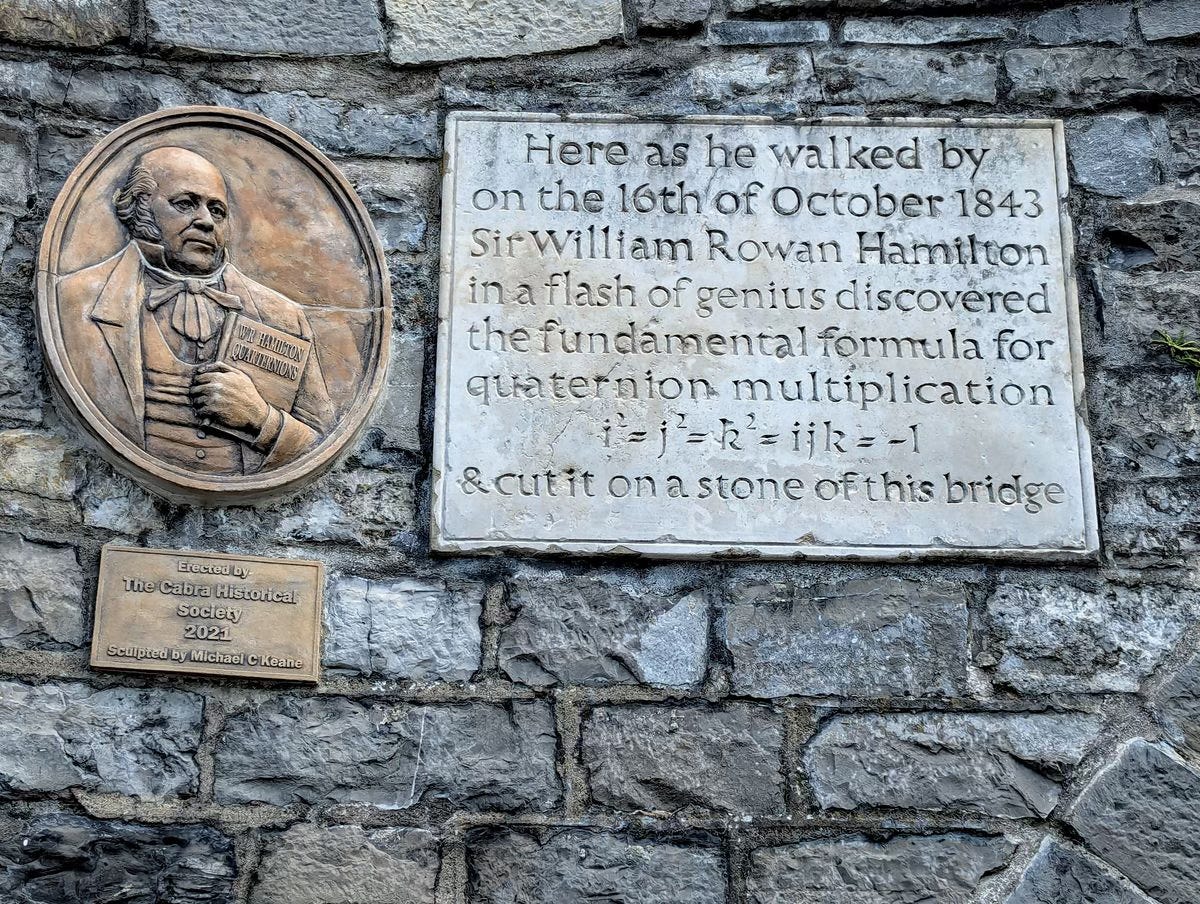
Irish mathematician Sir William Rowan Hamilton came up with the formula for quaternion algebra while walking; afraid of losing it, he stopped and carved the basic equation into the stone of Broom Bridge with his pocket knife. Wordsworth composed poetry while walking—often for days on end, before writing it down. I composed my TEDx talk on imaginative intelligence by pacing up and down, speaking aloud. I later figured I had at least six miles in the composition, and probably ten times as much in the rehearsal.
Have you ever found yourself getting up and moving around while brainstorming an idea? As my son said, it’s irresistible. Your body wants to move. When James Navé and I were working on Write What You Don’t Know, we knew we’d got something when Navé stood up and tucked himself into a corner of countertop next to the fridge.
It’s no news that walking supports creativity. Last week’s aha! moment was that it’s not specifically the walking. Simply getting up out of your chair engages your imaginative intelligence—the nonrational, creative, intuitive intelligence that communicates not in language, but through the body.
So, it’s my explorations of imaginative intelligence that gave me the insight. Now, “what I did” is suddenly an explicable, teachable, tryable strategy. We need those explications, because the rational intelligence tends to dismiss anything that isn’t grounded in reasons.
When you sit in a chair, in front of a notebook or computer, you’re tethered. This is “working position.” Rational intelligence engaged. You’re figuring it out. You’re trying to get it right. You’re hard-set in your head and largely unaware of your body—the seat of emotion and intuition—so your thinking is linear, heavily influenced by analysis, rules, teachings, and right/wrong judgments. You have the list of labeled pages in front of you—not the pages themselves, which are too many and too unruly. So, you’re ordering abstractions, not actual writing that’s alive with emotional and physical content.
But when you stand up, take steps, bend down and straighten up, you recruit your imaginative intelligence to the task. You see the whole book, spread out in front of you: still in discrete chunks but holistic, not fragmented. (This is also why detectives put all the evidence on a wall and stand staring at it. Notice, they’re not sitting.)
You left the “get it right” frame of mind in the chair, and your larger physical movements put you in more of a “what if” frame of mind. The pages you’re picking up are real pages, containing the real material of your story, not abstractions.
You’re looking for a flow that “feels right,” and your physical flow mirrors the flow of your story. You pick up a chunk because it feels like the next beat in the story, not because for some reason it ought to be.
Organizing is, usually, a rational-mind activity—but when it’s creative work that needs organizing and you don’t know what to do, recruit your imaginative intelligence by involving your body. The organization you come up with may not be perfect. It doesn’t have to be. You can always move things around later. But likely you’ll have the arc of your story, a narrative that make imaginative, emotional sense. It will feel right, or almost right. And you’ll get out of that stuck place at your desk, and see the way forward.
When I first learned what the word intelligence meant, my high school teacher framed it around me taking an IQ test. 70 was extremely low intellect; 145 and up was considered superior, genius, highly gifted.
I took the test; to this day, I can’t tell you which number comes after 36: 4, 9, 16, 25, 36. I’d like to tell you my IQ was 125, but I have no idea.
Does it matter?
Now we come to Imaginative intelligence, that name Allegra and I have given that mysterious functioning that no test can measure, nor should it.
Am I more imaginatively intelligent than you? Are you more imaginatively intelligent than I am? No, no, no, we are equal in the infinity of our unknowing.
I’m walking in some voodoo dream, layer upon layer, out in cosmic void where black spaces the stars, so far away they do not exist.
Why would anyone measure such black emptiness?
Could it be that what we call our imaginative intelligence contains the same range as that black endless everything "above the dingle stars"? I suspect it does.
“To arrive where you are, to get from where you are not, / You must go by a way wherein there is no ecstasy. In order to arrive at what you do not know / You must go by a way which is the way of ignorance. / In order to possess what you do not possess / You must go by the way of dispossession. / In order to arrive at what you are not / You must go through the way in which you are not. / And what you do not know is the only thing you know / And what you own is what you do not own / And where you are is where you are not.”
T.S. Eliot
Great advice! I’ve gotten unstuck on lots of things by sounding them out with my dog on walks. By sounding them out I mean talking to her out loud, which is also a fantastic tool you and Navé teach. It sounds like your son went on a creative walkabout. Cool!