
Don’t write the book!

If you want to write the book, and you’re having trouble writing the book, here’s the fix: don’t write the book.
.I learned this lesson on Love Child, my first book. Having been a publisher, I knew I’d need an outline and two sample chapters to get an advance. I knew what flag I was sailing under—in other words, what I stood for in writing this book: that families aren’t determined by the chains of DNA. I knew where my story ended, and it was a memoir, so I figured I knew the material.

But the more I worked on the outline, the more lost I felt. Where does the story start? How do I work in my mother’s story from before I was born? And then, later, how do I make these memories live on the page as if they’re fresh, rather than feeling tired and secondhand?
So, I started “generating material for the book” instead of writing the book. Not “writing.” And definitely not “writing the book.”
Material doesn’t have to be coherent or well-written. It just has to be emotionally connected—even if it’s not a story in the conventional sense. And it’s “material,” not the actual book. So you can go in any order, and digress and wonder and argue back against yourself as much as you want.
I have to keep reminding myself of this, as I sit down to the book on imaginative intelligence I want to write. Once again, I know what flag I’m sailing under: the overlooked intelligence that is our birthright as humans, the intelligence that glories in meaningful creativity, the intelligence that gives our lives meaning, the intelligence that AI, for all its terrifying power, cannot replicate. I know the material—or at least, much of it. I know what I want readers to take away from it.
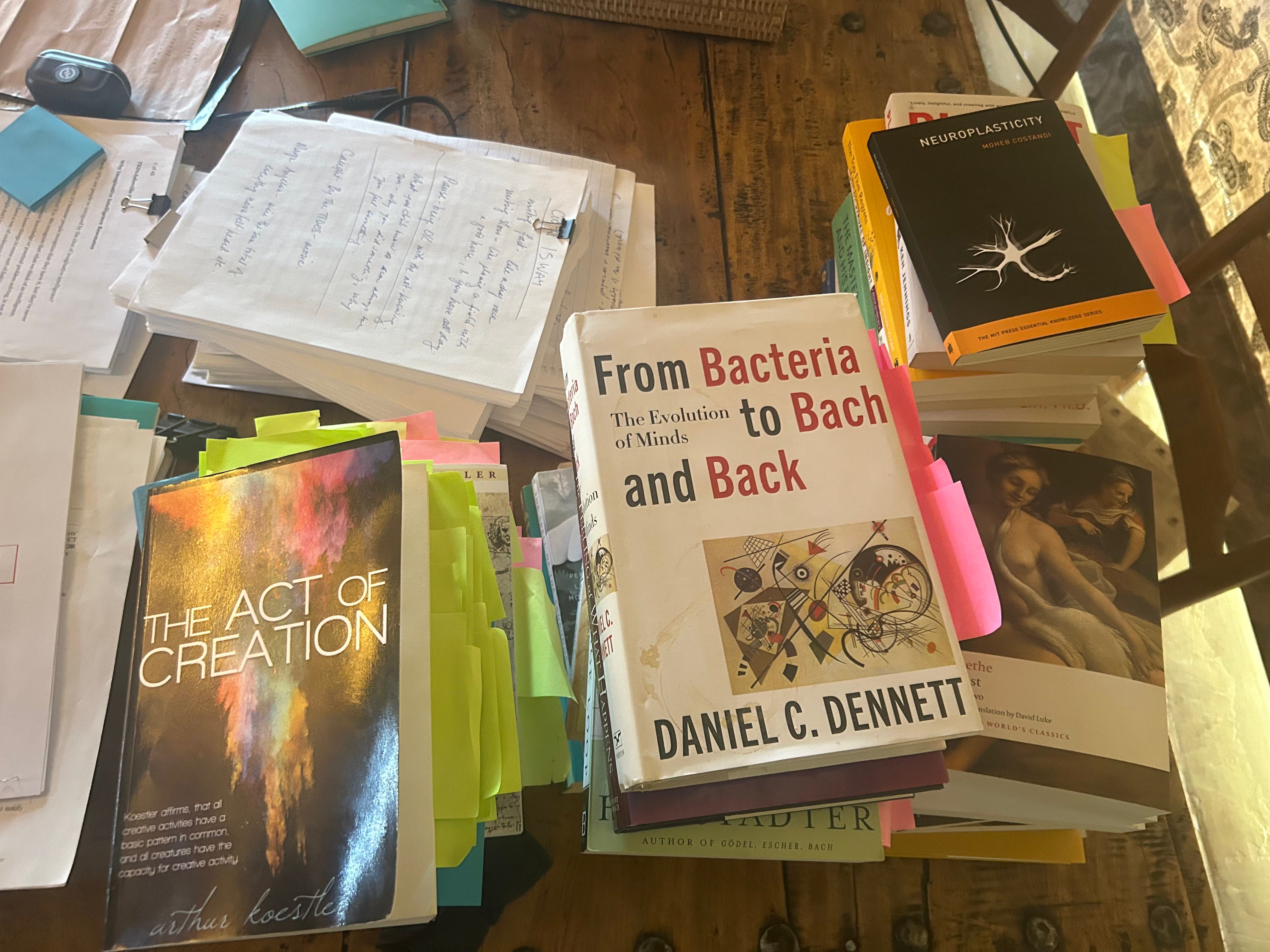
And I’ve made an outline, since I’d like to get a book deal. I even feel pretty good about it!
So, I couldn’t help it: I started at the beginning. And now I’m wondering, is it the beginning? It’s stopped feeling like the beginning, and it’s not gaining momentum. But I don’t know what else the beginning might be.
It’s not easy, this book-writing thing!
When I teach writing workshops, I do my best to give each participant a vision of the book they might write. (If they want to write one, that is—most do.) I find that really fun and satisfying, and I send them back into their lives motivated and energized. Which also makes me feel a bit guilty, because I know they’ll hit the place I’m hitting now. The can-I-do-this place. The am-I-good-enough place. The what-the-hell-am-I-thinking, why-would-I-ever-want-to-do-this place.
Not everyone hits this place. Stephen King, for an obvious example, doesn’t. That’s one reason I’m not so fond of his book on writing. Yes, it contains good advice. But it’s obvious that stories just pour out of him. I can’t imagine that he ever felt the need to attend a writing workshop.
My folks are not like him, and neither am I. That doesn’t make us “worse” writers. But it does make us less easy writers. I don’t want to say “facile” since I’m not being derogatory. I envy King’s facility with storytelling. I don’t get the sense that he’s ever had this feeling of stumbling around in a fog.
This one is a real pea-souper. Can’t see a thing. I’m stubbing my toes and bashing my shins, hurting myself as I follow what I hope is a train of narrative, then hit a wall. I think there’s a path, but I don’t know for sure. It’s possible there’s an abyss of despair and failure I’ll fall into.
I have to keep reminding myself, this is normal.
Not normal for every writer, but normal for those of us who are wildly un-adjacent to Stephen King. I’ve written a memoir, a novel, four books for writers, and countless screenplays, and I meet this fog every time. I will say that this fog is the thickest yet.
It’s easy to get discouraged. What if I just .... didn’t do it??? I could be content reading other people’s books and doing crosswords and going on walks, and doing what I know. Except, I don’t think I could be content. Some inner angel or demon drives me to Do Something.
And Doing Something seems to mean a challenge. Something that, when I do it, I’ll go, “Wow. I actually did it!”
It’s more than a work ethic; I could fill my days and my bank account working on other people’s books. It’s not ambition, in the sense of wanting to be famous. My only answer is that it’s my imaginative intelligence, urging me to be my best me.
The me I like best is curious and enthusiastic. That me wants to increase the sum of happiness in the world, by guiding people toward the deep satisfaction of creative work—especially people who, like me, grew up feeling less-than because they believed they weren’t creative. That me is thrilled when I’ve helped to open someone’s eyes to what they’re capable of, and given them tools to accomplish it with.
The concept of imaginative intelligence is the apotheosis of everything my creative collaborator James Navé and I have done so far. So, it’s become something like a duty for me to work to get it out into the world. A book gives it heft and respectability, beyond a TEDx talk. And it can reach more people than I could ever reach in person.
I felt a similar sense of oddly-placed duty when I was raising the money to make my short film Good Luck, Mr. Gorski (watch it here, it’s only 15 minutes long). What drove me to beg thousands of people to contribute $20 to the launch crew, to organize four live readings, to hold five bake sales and conduct two illegal raffles, wasn’t material or career ambition. I had a duty to Mr. and Mrs. Gorski—it was up to me to give them their lives back. Without giving away the story, I’ll just say that on the night of the moon landing, Neil Armstrong’s ex-neighbors rediscover their love for each other and their love of life.
They’re fictional. I made them up. But they’d started to feel like my children, and I wanted them to be happy! That would only happen if the film got made, and they, in the bodies of the actors, got their lives back.
The screenplay I’d written 20 years earlier was a suggestion. The decision to make the film was a promise.
Rather like my idea for this book. The promise has been made. It’s been given voice and put on paper—virtual paper and real paper.
This book is not a story of people, as Good Luck, Mr. Gorski is. It’s a story of ideas, insights, and possibilities. The only person, real or fictional, to whom I owe the duty of completing it is myself.
I loved listening to the story, Allegra. Your writing is so wonderful and gives Creative the permission to just be!
"This one is a real pea-souper. Can't see a thing. I'm stubbing my toes and bashing my shins, hurting myself as I follow what I hope is a train of narrative, then hit a wall. I think there's a path, but I don't know for sure. It's possible there's an abyss of despair and failure I'll fall into."
I think I am as interested in reading about your experiences writing the book as I am in reading the book itself! xoxo